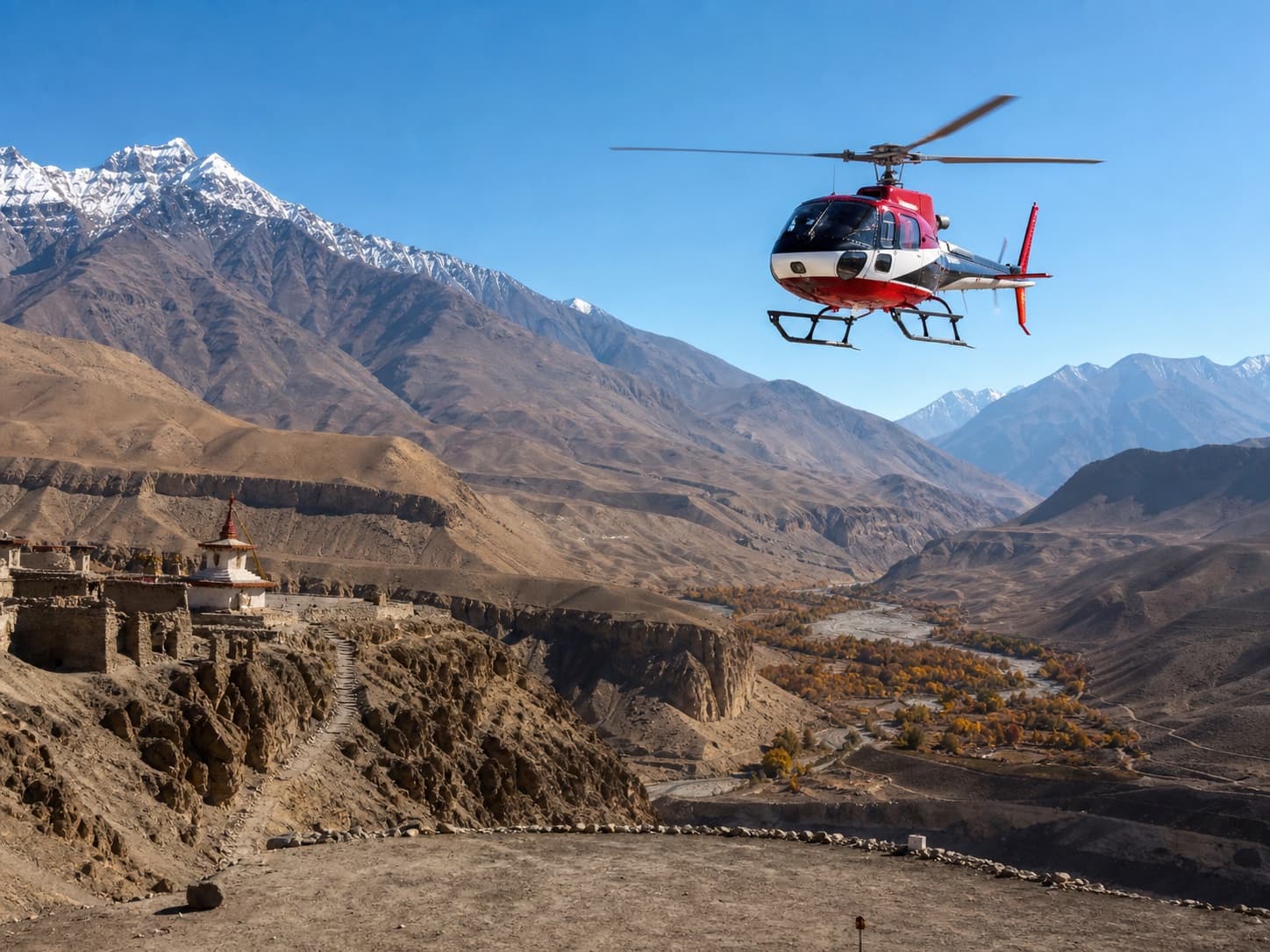
Helicopter on a high-altitude helipad in Nepal

Practical limits

Helicopter Weight and Baggage Limits in Nepal

Short answer

Nepali tour helicopters are planned by total weight rather than seat count. A single-engine H125 class helicopter seats up to five passengers near Kathmandu or Pokhara, but at a high-altitude landing point the usable load falls sharply, so operators calculate each flight from individual passenger weights, fuel and the altitude of the planned landing. Baggage allowances are correspondingly small on mountain routes and are confirmed per flight rather than by a fixed published figure.

Written and fact-checked by the Sharing Heli Pokhara flight deskLast reviewed

Planning unit
Total weight, not passenger count
Seats
Up to 5 on H125 / AS350 B3e class
Why weights are asked
Aircraft performance falls with altitude
Baggage on mountain routes
Small; confirmed per flight
High landings
May require shuttling in smaller groups
Accuracy
Under-reporting can cost you the landing
01

Why altitude changes the arithmetic

A helicopter generates lift by pushing air downwards. The higher and warmer it gets, the thinner that air becomes, and the less lift the same rotor produces at the same power. This is why performance charts, not seat counts, decide what a helicopter can carry on a given day.

In practice the difference is dramatic. A machine that lifts five passengers comfortably out of Pokhara at 820 metres may only be able to hover safely with two or three at a landing point above 5,000 metres. Nothing is wrong with the aircraft; that is simply physics.

Temperature matters too. A warm morning reduces performance further than a cold one at the same elevation, which is another reason mountain flights depart early.

02

What operators do with your weights

The figures you give are entered into a load and balance calculation alongside fuel and the planned landing altitude. That calculation determines how many people can be on board for the high segment, how much fuel can be carried, and whether the aircraft needs to shuttle passengers up in two groups.

Shuttling is normal on Everest-region itineraries and is not a sign of a problem. It does consume time, which is why it appears in the cost structure of those tours.

If a passenger's actual weight turns out to be significantly higher than declared, the crew has to redo that calculation at the helipad. The usual outcomes are a reduced landing, a longer shuttle or a cancelled high segment — with no refund, because the aircraft flew.

  • Give your weight in clothing and boots, not your best number
  • Include hand baggage and camera equipment in the estimate
  • Tell the desk if anyone in the group is notably tall or heavy
  • Update the operator if the group composition changes
03

Baggage on mountain routes

There is no single published baggage figure that applies across Nepali helicopter tours, because the allowance is whatever remains after passengers and fuel on that specific flight. On a short low-altitude scenic flight there may be reasonable room; on a high landing there may be almost none.

For scenic tours, plan to carry very little: warm layers you are wearing, a camera, water, and essential medication. For transfers and charters, ask for a written baggage allowance in kilograms as part of your quotation, and confirm the dimensions if you are carrying camera cases, ski or expedition equipment.

Excess baggage is not usually a payable extra on a mountain route. If it does not fit within the performance calculation, it stays behind.

04

Practical guidance for passengers

Wear your bulk rather than packing it. A down jacket on your body is part of the passenger weight either way, and you will want it at the landing point.

Keep medication, documents and anything irreplaceable on your person. If a load has to be reduced at short notice, hold baggage is the first thing to come off.

If you have a specific requirement — a wheelchair, oxygen, a large camera rig, a child seat — raise it at enquiry stage rather than on the day. Most of these are workable with notice and none of them are workable as a surprise at the helipad.

How altitude affects what a helicopter can carry

Landing elevationExample pointsEffect on usable loadCommon consequence
Under 1,500 mKathmandu, PokharaFull seating normally availableStandard boarding
3,000 to 4,000 mKyanjin Gompa, Muktinath, SyangbocheNoticeably reducedWeights checked carefully; load managed
4,000 to 5,000 mAnnapurna Base Camp area, GosaikundaSignificantly reducedFewer passengers per landing, short ground time
Above 5,000 mKala Patthar and similar viewpointsSharply reducedPassengers usually shuttled in smaller groups

This table explains the direction and cause of the effect; it is not a performance chart. Actual figures are calculated by the operating carrier for the specific aircraft, temperature, fuel state and landing point on the day, and only that calculation is authoritative.

Common questions

Questions travellers ask

What is the weight limit for a helicopter tour in Nepal?

There is no single limit. The operating carrier calculates a maximum total load for each flight from the aircraft type, temperature, fuel and the altitude of the planned landing, then works backwards to how many passengers and how much baggage can be carried.

How much baggage can I bring on a helicopter tour?

On scenic mountain routes, very little — plan for warm layers, a camera and essentials. On transfers and charters, ask for a written allowance in kilograms as part of the quotation, because it depends on the routing.

Why do you ask for each passenger's weight individually?

Because load and balance both matter. The crew needs the distribution, not just the total, to seat people correctly and to know whether a high-altitude landing is achievable.

What happens if a passenger weighs more than declared?

The calculation is redone at the helipad. That can mean a reduced landing, splitting the group into an extra shuttle, or dropping the high segment — and because the aircraft still flew, a refund is unlikely.

Can five passengers land at Kala Patthar together?

Often not. Above 5,000 metres usable load falls sharply, so operators commonly shuttle passengers up in smaller groups. That is standard practice on Everest itineraries and is built into the schedule.

Is there an extra fee for heavier passengers?

Not usually as a surcharge, but a heavier group may need an additional shuttle or a larger share of the aircraft, which affects the plan and sometimes the price. Declaring weights accurately at enquiry stage avoids surprises.

Get a written quote for your date

Send the route, date range, passenger count and approximate weights. The Pokhara desk returns feasibility, the current fare and the operating carrier in writing.