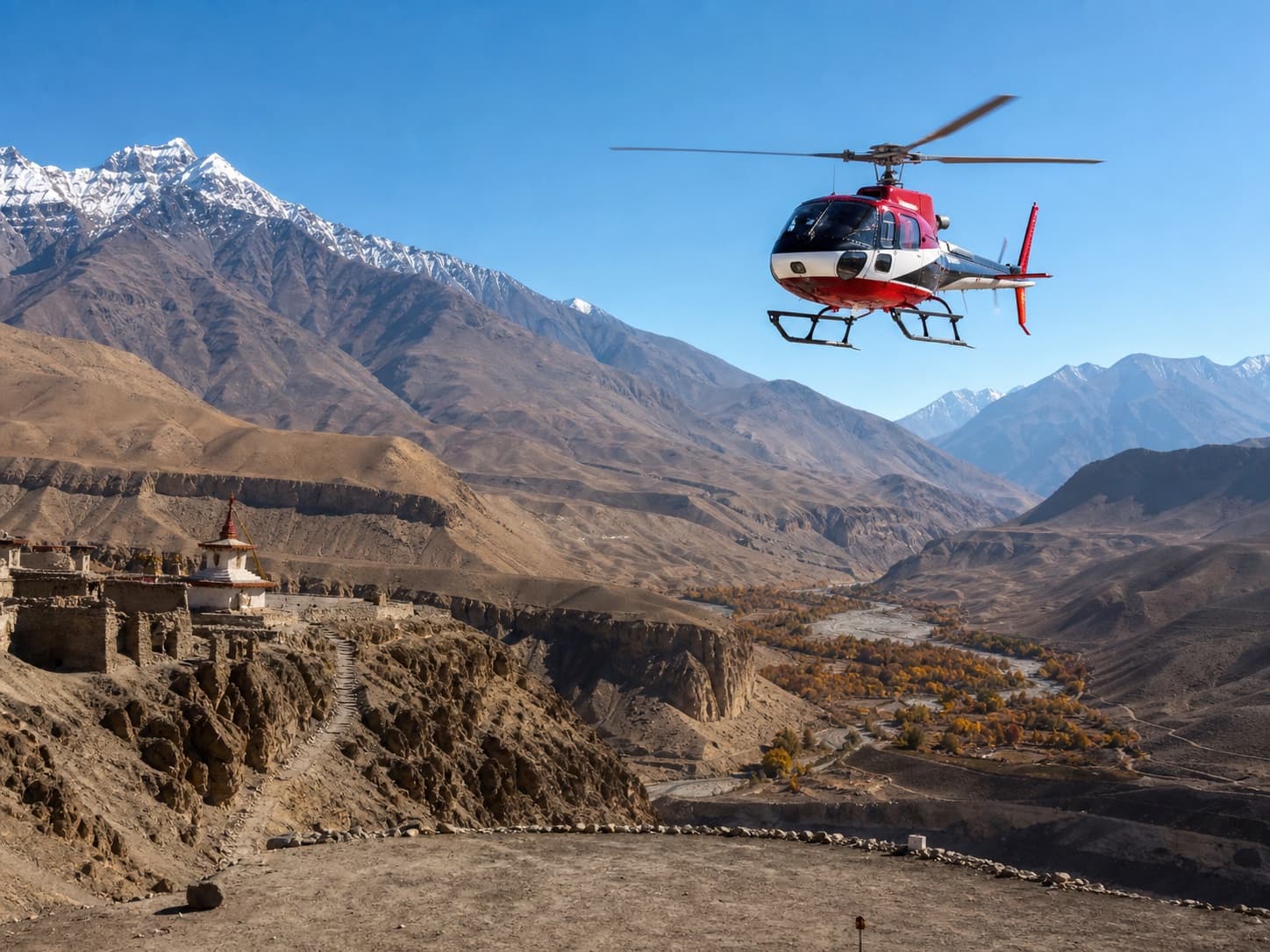
Helicopter near Muktinath temple in Mustang, Nepal

Pilgrimage route

Pokhara to Muktinath by Helicopter

Short answer

A Pokhara to Muktinath helicopter flight takes roughly 45 to 55 minutes each way and lands close to the temple at about 3,700 metres in Lower Mustang. It is the route most used by pilgrims who cannot manage the long road journey or the trek, and it is normally flown as a same-day return with ground time at the temple, weather permitting.

Written and fact-checked by the Sharing Heli Pokhara flight deskLast reviewed

Departure
Pokhara (Jomsom also possible)
Flight time
About 45 to 55 minutes each way
Temple altitude
Approximately 3,710 m
Ground time
Typically 1 to 2 hours, weather dependent
Formats
Shared seat or private charter
Fees
Annapurna Conservation Area charges apply
01

Why pilgrims choose the helicopter

Muktinath is one of the most significant pilgrimage sites in both Hindu and Buddhist tradition, and it sits in one of the least accessible parts of Nepal. The overland route via Beni and Jomsom is a long, rough drive that takes most of two days each way; the trekking route takes longer still.

The helicopter compresses that into a morning. For elderly pilgrims, families travelling with children, and anyone with mobility or cardiac considerations, it is often the difference between making the journey and not making it at all.

The flight itself follows the Kali Gandaki gorge north between Dhaulagiri and Annapurna — the deepest gorge on earth by some measures — before the landscape opens into the arid, wind-scoured plateau of Mustang.

02

What the day usually looks like

Departures are early, because the Kali Gandaki develops strong up-valley winds from late morning that make the corridor uncomfortable and sometimes unflyable. A typical plan lifts off shortly after first light, lands near the temple, and returns before the wind builds.

Ground time is usually one to two hours, enough for darshan, the 108 water spouts and the Jwala Mai flame. Groups that want longer should book a private charter, since waiting time on the ground is aircraft time and has to be planned and paid for.

Some itineraries stage through Jomsom, either to refuel or to wait out a weather window. This is normal practice on this route, not a sign that something has gone wrong.

03

Altitude and physical preparation

Muktinath sits at roughly 3,710 metres. Flying there from Pokhara at 820 metres means gaining nearly 2,900 metres in under an hour, with no acclimatisation. Most healthy travellers manage it without difficulty for a short visit, but it is a real altitude exposure and should be treated as one.

Move slowly at the temple, drink water, and tell the crew immediately if anyone feels unwell. Travellers with heart conditions, respiratory illness, uncontrolled blood pressure or advanced pregnancy should get medical advice before booking. Ground temperature can be near freezing in the early morning even outside winter.

  • Warm layers and windproof outer clothing, in every season
  • Comfortable shoes for uneven temple steps
  • Any regular medication carried on the person, not in baggage
  • Accurate individual weights supplied at booking
04

Shared seats, group charters and combined routings

Muktinath sees steady pilgrimage demand, so shared-seat matching is more achievable here than on many Nepali routes, particularly in the pilgrimage seasons. It still depends on a workable combination of passengers and weights on your specific morning.

Family and temple groups frequently take the whole aircraft instead, which fixes the departure time and lets ground time be planned around the group rather than around strangers. Combined routings that add Annapurna Base Camp, Tilicho Lake or Kagbeni on the same flight are common; ask for the full routing in writing so the extra sectors and fees are visible.

Published rates for Muktinath flights

Useful for sanity-checking any quote you receive. These figures are advertised publicly by other Nepali operators and agencies and were last checked on . They are not our prices.

Publicly advertised Nepal helicopter rates by route and pricing basis, in US dollars
RoutePriced byPublished range (USD)Source
Muktinath, from Pokharaper aircraft (private)around $3,200Nepal Helicopters
Muktinath, from Kathmanduper aircraft (private)around $4,800Nepal Helicopters

Rates below are advertised by third-party Nepali operators and agencies on their own public websites. They are indicative market context only, usually exclude some fees, and change with season, fuel and demand. Most published figures exclude national park and municipality fees, some exclude VAT, and a per-person figure normally assumes a full aircraft. Ask any provider — including us — to confirm the basis, inclusions, currency and validity in writing before you pay.

Sources: Nepal Helicopters

Ways to reach Muktinath compared

MethodTime from PokharaPhysical demandWeather sensitivity
HelicopterAbout 45 to 55 minutes each wayLow; short walk at the templeHigh — morning departures strongly preferred
Road via Beni and JomsomRoughly 1.5 to 2 days each wayHigh; rough road, long hoursModerate to high in monsoon
Fixed-wing to Jomsom plus jeepAround half a day each wayModerateHigh — Jomsom winds close the strip by mid-morning
TrekkingSeveral daysVery highModerate

Durations are indicative and depend on road conditions, weather and season. The helicopter option remains subject to wind in the Kali Gandaki corridor, which typically strengthens from late morning.

Common questions

Questions travellers ask

How long is the helicopter flight from Pokhara to Muktinath?

Roughly 45 to 55 minutes each way, depending on routing, wind and whether the flight stages through Jomsom.

How much time do we get at the temple?

Usually one to two hours on a standard itinerary. A private charter can allow longer, but ground time is aircraft time and must be agreed in advance.

Is Muktinath by helicopter suitable for elderly pilgrims?

It is frequently the reason people choose it, because it removes two long days of rough road travel. The temple is still at about 3,710 metres and involves walking on uneven ground, so anyone with a heart or lung condition should seek medical advice first.

What is the best season for a Muktinath helicopter flight?

March to May and September to November generally offer the most stable conditions. Winter flights operate but are colder and shorter on daylight; monsoon months carry more cancellation risk.

Can we combine Muktinath with Annapurna Base Camp?

Yes, combined routings from Pokhara are common. Each additional sector adds flying time and possibly another landing fee, so ask for the whole routing to be itemised in the quotation.

Can the flight be cancelled after we take off?

Yes. Wind in the Kali Gandaki gorge can rise quickly and the crew may turn back or hold at Jomsom. Ask in advance how a turnback is treated commercially.

Get a written quote for your date

Send the route, date range, passenger count and approximate weights. The Pokhara desk returns feasibility, the current fare and the operating carrier in writing.