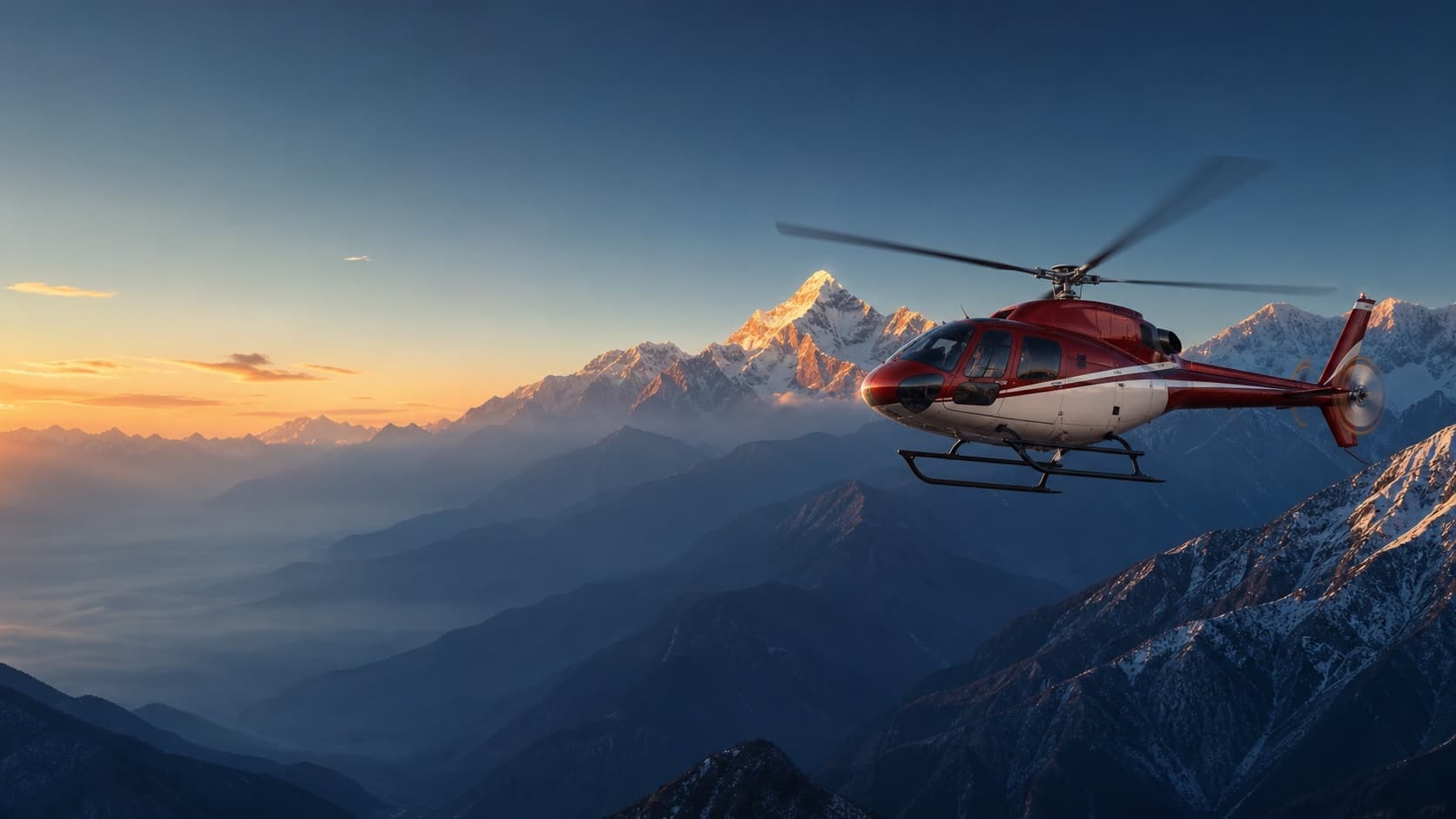
Private charter helicopter in Nepal

Charter pricing

Private Helicopter Charter Cost in Nepal

Short answer

A private helicopter charter in Nepal is priced per aircraft per flying hour, not per passenger. The quote covers the hours actually flown including any empty positioning legs, plus fuel, landing and park fees, crew time and waiting time on the ground. Because the whole aircraft is yours, the total is the same whether one person or five travel, which is why charter often matches shared-seat pricing once a group reaches four or five people.

Written and fact-checked by the Sharing Heli Pokhara flight deskLast reviewed

Priced as
Per aircraft, per flying hour
Passengers
Up to 5, subject to combined weight
Departure points
Kathmandu, Pokhara, and permitted helipads
Positioning legs
Chargeable if the aircraft flies empty to reach you
Ground waiting
Usually billed, rates vary by operator
Typical uses
Custom routing, transfers, filming, pilgrimage, time-critical travel
01

The flying hour is the unit that matters

Charter pricing in Nepal is built on aircraft time. Everything else — fuel, crew, maintenance reserve, insurance — is folded into an hourly rate for the aircraft type, and your quote is essentially that rate multiplied by the hours your trip will consume.

This is why a short Pokhara scenic flight and a multi-sector Everest day look so different on paper. It is also why adding a single extra landing can move a quote noticeably: the aircraft is running, and the clock does not stop while you are on the ground.

02

Positioning: the cost travellers most often miss

Helicopters do not wait at every airport. If the nearest available aircraft is based in Kathmandu and your flight departs Pokhara, someone has to pay for the empty leg that brings it there, and possibly the empty leg that takes it home.

Good quotes state positioning explicitly. If a figure looks unusually low, positioning is the first thing to ask about — and if an operator can combine your movement with another job on the same day, that is where genuine savings come from.

The reverse is also true. Being flexible about your departure point or time occasionally lets you pick up an aircraft that is already in position, which is the single most effective way to reduce a charter bill.

  • Ask whether the quoted hours include empty positioning legs
  • Ask where the aircraft is based on your date
  • Ask whether ground waiting time is billed, and at what rate
  • Ask what happens if the return leg is delayed by weather overnight
03

Weight is a hard constraint, not a guideline

A single-engine H125-class helicopter seats five passengers at low elevation. At high-altitude landing points that number falls, sometimes substantially, because thinner air reduces the power available to hover and land safely.

This is why operators ask for individual passenger weights rather than a headcount, and why an accurate answer at booking is in your own interest. An underestimate discovered at the helipad forces a reshuffle, a second shuttle, or a cancelled landing — all of which cost time and money.

04

Where published charter rates sit

As of August 2026, Nepali operators publish single-engine helicopter charter rates of roughly USD 1,300 to 3,000 per flying hour, with the spread driven by aircraft type, route and season. Whole-aircraft route prices follow from that: Pokhara to Annapurna Base Camp at roughly USD 2,200 to 2,500, Pokhara to Muktinath around USD 3,200, Langtang around USD 2,400, Gosaikunda around USD 2,000, Kathmandu to Lukla around USD 3,200, and an Everest scenic charter at roughly USD 5,800 to 6,500.

Those figures are a useful floor for judging a quote, but they rarely include everything. Park and conservation fees, landing charges at specific helipads and ground waiting are the three items most often quoted separately, and positioning is the one most often left unmentioned altogether.

05

When charter beats buying seats

Run the arithmetic before assuming charter is the expensive option. Four or five per-seat fares on the same route frequently approach the cost of the whole aircraft, and the charter comes with control over departure time, routing and ground time that a shared flight cannot offer.

Charter also removes the matching risk entirely. A shared seat depends on other travellers appearing; a charter depends only on weather and aircraft availability. For a group with one fixed day in Nepal, that difference is usually worth more than the price gap.

Published charter rates by route

Useful for sanity-checking any quote you receive. These figures are advertised publicly by other Nepali operators and agencies and were last checked on . They are not our prices.

Publicly advertised Nepal helicopter rates by route and pricing basis, in US dollars
RoutePriced byPublished range (USD)Source
Everest Base Camp / Kala Patthar scenic tour, from Kathmanduper person (shared)$1,240 – $1,600Flight Everest, Best Heritage Tour
Everest Base Camp / Kala Patthar scenic tour, from Kathmanduper aircraft (private)$5,800 – $6,500Flight Everest, Nepal Helicopters
Annapurna Base Camp, from Pokharaper aircraft (private)$2,200 – $2,500Best Heritage Tour, Nepal Helicopters
Annapurna Base Camp, from Pokharaper person (shared)$440 – $500Best Heritage Tour (five-passenger group-joining rate)
Annapurna Base Camp, from Kathmanduper aircraft (private)$4,200 – $4,500Nepal Helicopters
Muktinath, from Pokharaper aircraft (private)around $3,200Nepal Helicopters
Muktinath, from Kathmanduper aircraft (private)around $4,800Nepal Helicopters
Langtang valley, from Kathmanduper aircraft (private)around $2,400Nepal Helicopters
Gosaikunda, from Kathmanduper aircraft (private)around $2,000Nepal Helicopters
Kathmandu to Lukla transferper aircraft (private)around $3,200Nepal Helicopters
General charter rate, single-engine helicopterper flying hour$1,300 – $3,000Nepal Helicopters

Rates below are advertised by third-party Nepali operators and agencies on their own public websites. They are indicative market context only, usually exclude some fees, and change with season, fuel and demand. Most published figures exclude national park and municipality fees, some exclude VAT, and a per-person figure normally assumes a full aircraft. Ask any provider — including us — to confirm the basis, inclusions, currency and validity in writing before you pay.

Sources: Flight Everest, Best Heritage Tour, Flight Everest, Nepal Helicopters, Best Heritage Tour, Nepal Helicopters

Charter quote components to check line by line

Line itemWhat to askWhy it matters
Aircraft hourly rateWhich aircraft type, and the rate per hourSets the base of the whole quote
Estimated flight hoursRoute breakdown by sectorLets you sanity-check the total
Positioning legsAre empty legs included or extraMost common source of quote differences
Fuel and refuelling stopsWhere the aircraft refuels on this routingAdds time as well as cost
Park and conservation feesIncluded or payable separatelyOften excluded from headline figures
Landing feesWhich helipads, and at what chargeVaries by point used
Ground waitingBilled per hour or includedLong temple or photo stops add up
Weather contingencyWhat happens on postponement or overnight delayDecides who carries the cost of a weather day

Ask for every line below to be shown as included or excluded. A quote that lists only a single total is not comparable with one that itemises, and the difference is usually park fees, positioning and ground waiting.

Common questions

Questions travellers ask

How much does it cost to charter a helicopter in Nepal?

It is quoted per aircraft per flying hour, so the total depends entirely on your routing, landings and positioning. Ask for an itemised quote covering hours, positioning, fees and waiting time rather than comparing single headline numbers.

Is charter cheaper than buying five seats?

Often it is close. Once a group reaches four or five people, per-seat fares on the same route frequently approach the whole-aircraft price, and the charter adds control over timing and routing.

Can I hire a helicopter for a single one-way transfer?

Yes. Point-to-point transfers are common, for example Lukla to Kathmandu when flights are backed up, or Pokhara to Jomsom. Whether the return empty leg is chargeable depends on where the aircraft is needed next.

How many passengers fit on a charter?

Up to five on the single-engine types used for most Nepali mountain work, but combined weight and landing altitude can reduce that. Provide accurate individual weights and the operator will plan the load properly.

Do I pay for the helicopter while it waits on the ground?

Usually yes, though the rate and any free allowance vary by operator. This is worth confirming in writing if your plan includes a long temple visit, a photo shoot or a meeting on the ground.

Who operates the aircraft on a charter?

A licensed Nepali air operator. The coordinating company should name the operating carrier in the written quotation before you pay a deposit, and you are entitled to ask for that in writing.

Ask for an itemised charter quote

Send the routing, date, passenger count and approximate weights. You get hours, positioning, fees and waiting time broken out, with the operating carrier named.